


Artificial Intelligence (AI) in Healthcare: How AI Tools Tackle Admin
When people hear “AI in healthcare,” they often imagine something futuristic — robotic surgeons or fully automated hospitals.
That's far removed from what clinicians actually need: help with the medical documentation and clinical documentation that fill their evenings.
A landmark observational study in Annals of Internal Medicine found that physicians spend nearly 2 hours on EHR and desk work for every hour of direct patient care during office hours, plus an additional 1-2 hours nightly on EHR tasks outside work.
This growing documentation burden is one of the biggest drivers of clinician burnout.But artificial intelligence is starting to change that.
Imagine instead AI that helps you finish your medical charts before dinner — giving you more efficiency and time for what really matters.
In this guide, we’ll explain:
- Why medical documentation consumes so much clinician time
- How artificial intelligence automates healthcare
- The state of AI in healthcare today
- How AI healthcare tools support billing and reimbursement, communication among providers, and risk management
- What clinicians should know before adopting AI documentation tools
Admin in the healthcare industry
One of the most overbearing daily tasks in healthcare isn’t reviewing complex lab reports or making critical diagnostic decisions. It’s the hours spent clicking through the electronic health record (EHR) and completing administrative tasks.
Every patient visit requires clinicians to record key information including:
- Patient history
- Symptoms and exam findings
- Clinical impressions
- Treatment plans
- Follow-up instructions
This patient care documentation serves multiple purposes. It supports:
Because documentation plays such a critical role, clinicians must be diligent about producing accurate documentation for every patient encounter.
Unfortunately, traditional workflows often make this difficult. Recent studies conclude that clinicians spend an average of 1.77 hours daily completing documentation beyond their usual work hours. That’s roughly 35 hours a month — an entire work week spent doing paperwork.
Other studies suggest that the demanding hours of documentation drive healthcare professionals to burnout. It also associates the poor usability of EHR with burnout.
In fact, 63% of physicians in the US claim to be emotionally exhausted due to burnout.
Why traditional solutions haven’t solved the problem
Healthcare organizations have tried multiple strategies to reduce the documentation burden. These include:
- Expanding EHR capabilities
- Hiring medical scribes
- Creating structured templates
- Increasing administrative staff
While helpful, these approaches often add complexity rather than reducing the underlying medical documentation workload.
Clinicians remain responsible for producing documentation that clears many bars: adhering to documentation standards, supporting billing and reimbursement, and ensuring legal compliance and regulatory oversight.
Meanwhile, the volume of required clinical documentation is only increasing.
Throwing more staff and scribes at the problem isn’t a cure — it’s just more gauze on an open wound.More staff can’t solve the deep-rooted inefficiency of how healthcare today handles medical documentation.
"The leading EHRs were never built with any understanding of the rituals of care or the user experience of physicians or nurses. A clinician will make roughly 4,000 keyboard clicks during a busy 10-hour emergency-room shift." — Dr. Abraham Verghese, The New York Times
Only 22% of clinicians surveyed find it easy to document patient care conversations in the EHR.
The workflow process isn't helping the healthcare team like it should.
Is artificial intelligence the answer? Or just another bandaid? Let’s understand how AI actually addresses this challenge in the healthcare system.
The best application of artificial intelligence is when we let it do the administrative tasks that take away from care.
Here’s how AI can help you minimize (and eliminate) the burden of paperwork.
1. Real-time medical documentation
An AI scribe (or digital scribe) listens to your patient interactions in real-time and converts the entire conversation into well-formatted notes as soon as the session ends.
These AI-powered virtual scribes use advanced machine learning to:
- Convert speech to text (speech recognition and translation) with accurate medical terminology
- Structure information into standard formats (like SOAP notes)
- Integrate with existing EHR systems and consolidate all the data
This improves:
- Timely documentation
- Accurate documentation
- Communication among providers
- Compliance amidst regulatory uncertainty
Your quickly-completed notes improve diagnostic accuracy and continuity of care. You maintain a natural flow of conversation with your patient, and your notes get done in tandem. It also means every clinician on a patient's care team is working from the same information.
AI scribe example
.png)
Freed is the industry-leading AI medical scribe designed to capture the patient conversation during the visit and generate a structured clinical note that you can easily customize and push to your EHR.
Freed's models are trained in clinical contexts, so they understand the nuances of the visit and medical terminologies. Advanced AI enables it to adapt to your edits, train on your templates, and write in a way that sounds like you.
Freed is HIPAA and HITECH compliant, SOC II Type 2 certified, and follows strict data security and compliance practices.
2. Automated coding and billing support
For a large majority of US-based clinicians, billing tasks just add to the admin overload.
It's no surprise: for every visit, you have to choose from 69,000 ICD-10 diagnosis codes and match them to the right CPT codes for procedures. All this has to be done in compliance with payer requirements and documentation guidelines.
Here's another great example of artificial intelligence. With real-time clinical documentation and guidelines, you can properly train artificial intelligence to identify relevant billing codes and make sure every note meets billing requirements.
These tools can also:
- Flag missing elements in reimbursement requests
- Track coding patterns
- Suggest more applicable codes
AI medical coding example
.png)
Freed helps streamline the billing process by identifying relevant ICD-10 diagnosis codes directly from the clinical context of the visit.
As soon as the note is generated, suggested codes appear for review — eliminating the need to manually search through thousands of possible diagnosis codes. These suggestions adapt to the clinician’s specialty and documentation patterns, helping prepare notes for billing faster and with less administrative work.
3. Clinical decision support
While AI technology can streamline documentation, its biggest impact lies in supporting clinical judgment.
Behind every clinical decision goes an overwhelming amount of medical data processing.
You have to review lab values, drug interactions, treatment protocols, and many other variables. Even with years of experience, keeping track of all these moving pieces — while staying current with new research — can feel like solving a puzzle that keeps adding new pieces.
None of this should live in one person's head. In fact, this sentiment is why we started documenting the medical record in the first place.
“The human mind simply cannot carry all of the information about all of the patients in the practice” - Dr. Larry Weed, Founder of the Medical Record
Now, AI is stepping in to close the gaps.
AI tools can pull together patient data from multiple sources, check it against clinical guidelines, and flag potential risks — all before you've had to dig through a single study. You get evidence-based recommendations when and where they matter most.
So instead of drowning in information, you can act on it.
Clinical decision support example
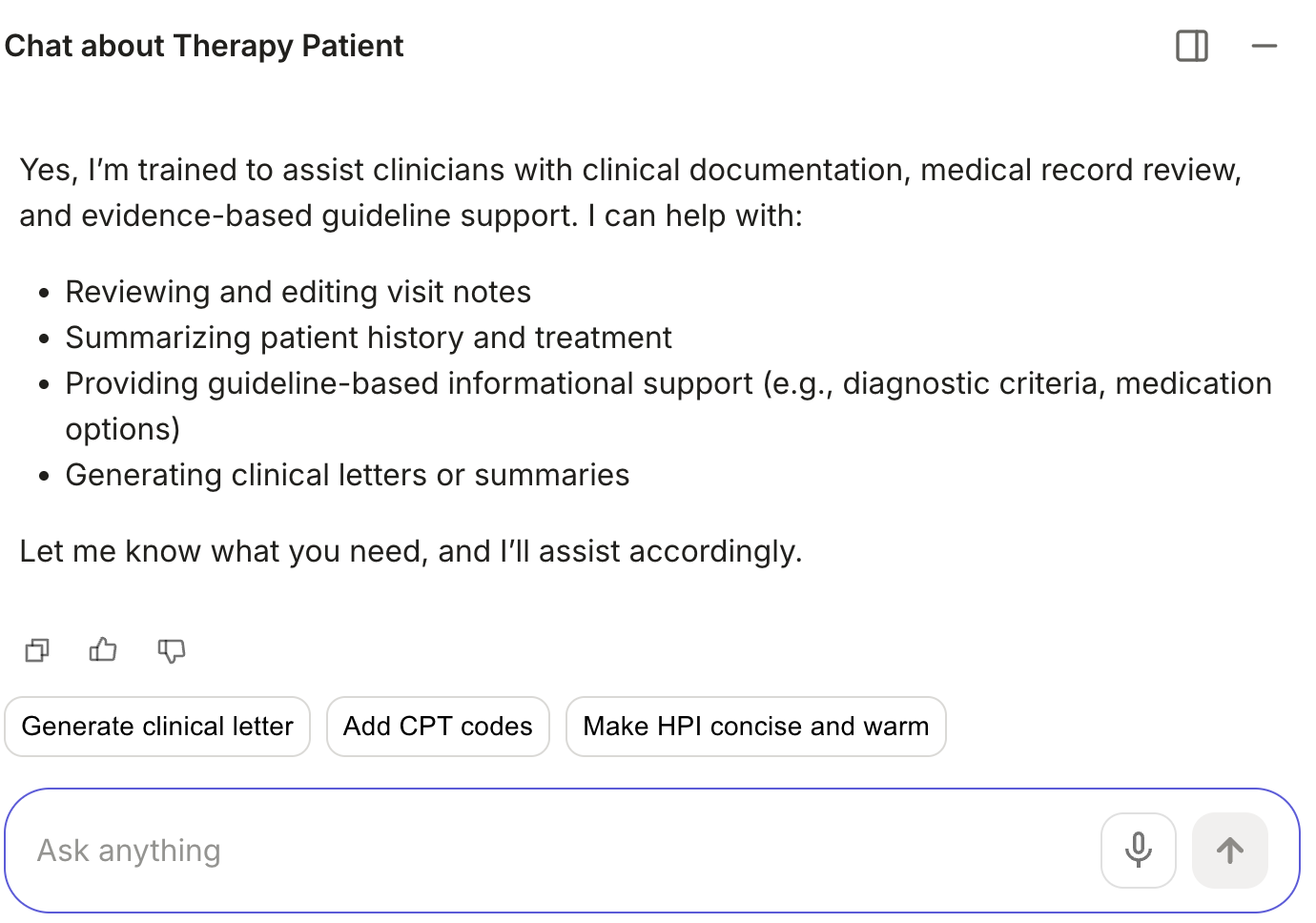
Freed has expanded into a clinician assistant — pulling patient details forward, adding visit summaries, and:
- Providing clinical decision support
- Helping you think through A&Ps
- Summarizing key findings with dates
The clinician assistant can be accessed both before and after capturing a visit. You can ask pre-visit questions about a patient you've seen before by clicking the "Ask anything" chat box at the bottom of the screen.
Learn more about Freed’s clinician assistant
4. Patient instruction automation
No two patient interactions are the same. Documenting a 15-minute consultation can eat up half an hour or more.
Whether you’re detailing post-operative care steps, explaining a new medication regimen, or outlining lifestyle modifications for chronic condition management — you have to be clear and thorough.
More importantly, you have to personalize these instructions for every patient’s specific needs and concerns.
AI-augmented healthcare systems can create customized notes with detailed after-visit summaries. Adjust these instructions based on patient understanding levels. And save yourself the hassle of writing repetitive instructions and solving doubts over endless follow-up calls.
Patient letters and referral example
.png)
Freed automatically generates context-friendly after-visit instructions, referrals, certifications, and more as part of the documentation process. Once the note is complete, clinicians receive a clear summary of the visit with actionable next steps written in plain language. These instructions can be quickly reviewed and shared with patients, saving clinicians time while helping ensure patients leave with clear guidance about their care.
5. AI receptionist and front desk automation
Between seeing your patients and charting notes, your clinic’s operations can take a backseat.
This is another area where the use of AI can streamline and automate your routine workflows to keep everything under control.
In addition to appointments, machine learning systems can also optimize resource allocation for your organization. Assign tasks to your staff based on their bandwidth to prevent burnout or wasted time.
AI receptionist example
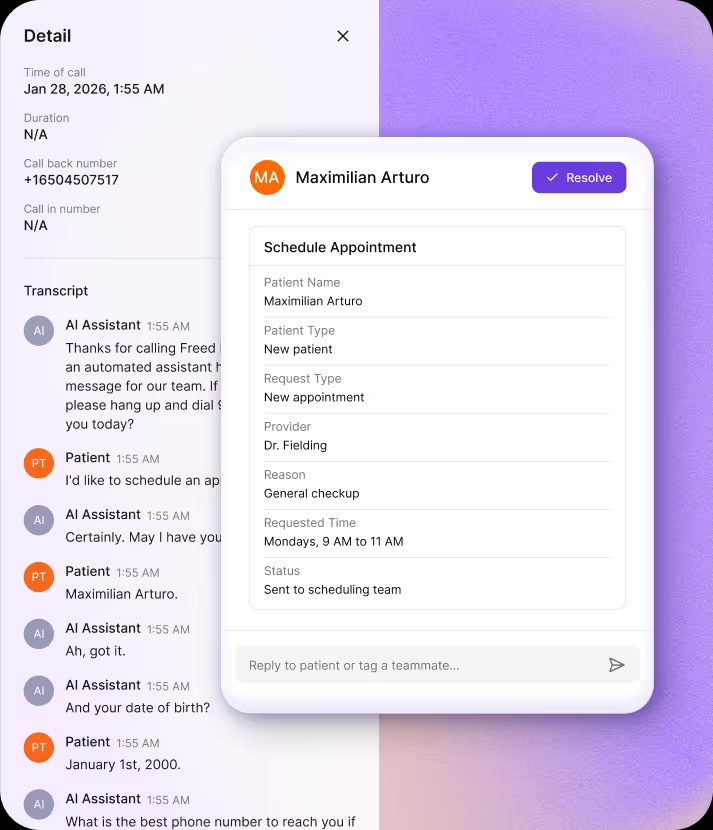
Freed has evolved beyond an AI scribe to launch an AI receptionist that manages patient communications and converts calls into booked appointments.
AI-powered front desk tools can:
- Answer calls
- Support structured intake and scheduling
- Summarize calls and next steps
See the evolution from traditional front desk to AI reception
6 common concerns about the adoption of AI in healthcare
It's easy to be an AI skeptic — there's so much to care about: patient data privacy, HIPAA compliance, and clinical precision.
After all, the stakes are high. A misunderstood medication name, an incorrect diagnosis code, or a data privacy breach can have serious implications.
So, let’s answer some of these questions and address the critical concerns around AI adoption in healthcare.
1. Data security and HIPAA compliance
The concern: "How can I be sure my patients' data is protected when using AI tools?"
Patient data demands the highest level of protection — and AI documentation systems are built with that in mind. Some patients may have ethical concerns around whether AI tools actually protect their data. Luckily, most platforms use secure infrastructure and encryption by default, and are designed to meet HIPAA requirements so sensitive information stays protected at every step.
For example, Freed operates on Microsoft Azure's secure cloud infrastructure and follows strict data management protocols. It doesn’t store any patient recordings and automatically deletes notes after 30 days.
See Freed's data and compliance policies
2. Cost and ROI
The concern: "Is this another expensive technology that won't deliver on its promises?"
AI tool adoption can deliver instant returns through time savings and higher efficiency. When you consider the hours saved on documentation alone, you’d see an ROI on your monthly subscription cost for an AI tool. You can even use free trials to discover what a tool brings to the table.
Research suggests that AI scribes have the upper hand when compared to the cost of hiring in-person medical scribes.
“In our study, monthly and initial software costs are $1850/month and $1000 to onboard a clinician. Locally, a scribe costs ∼$3050/month, inclusive of recruiting and training costs. Utilizing DAX over an in-person scribe could equate to ∼$13,400 to ∼$14,400 in cost savings, although additional work that in-person scribes perform (including entering orders or patient instructions) is not possible with DAX. These costs may not be generalizable given our pilot study was performed at a large academic institution.”
3. Quality control and accuracy
The concern: "Can I trust AI tools to maintain the same level of accuracy I add to my notes?"
Modern AI tools work on sophisticated large language models (LLMs). These models are designed to achieve remarkable accuracy. They can also learn your specific guidelines and adapt to your preferences over time. As a result, AI tools can reach the highest levels of accuracy.
Besides, think of artificial intelligence as a powerful assistant designed to handle the administrative burden on your behalf. While AI tools do the heavy lifting, you can always review and edit the output for stricter quality control.
This combination of AI efficiency and human oversight promises both speed and accuracy.
4. Impact on patient relationships
The concern: "Will AI tools interfere with my patient care?"
If anything, many clinicians report the opposite. The EHR already pulled clinicians away from patients — AI brings them back. Address privacy worries and ethical concerns upfront, and what's left is a tool that makes you more efficient and more present. Conversations feel like conversations again. That's not a small thing — 81% of clinicians believe that documentation tasks impede patient care.
That's the importance of AI: a chance to be present in the moment on and off the clock.
5. Learning curve and adoption
The concern: "Will this take too long to learn? Will it slow me down initially?"
No one has time for a steep learning curve. Luckily, most AI-augmented healthcare systems are designed for the flow of clinical work.
This means:
- Little-to-no training required
- A user friendly-interface
- Responsive customer support
6. Integration with existing systems
The concern: "Will this be yet another system I need to learn and manage? Will it work with my current EHR?"
AI healthcare technology should fit into your workflow, not the other way around. That's why most (if not all) AI applications will integrate with EHR platforms, or offer their own work arounds.
Looking ahead: The future of AI in healthcare
Good documentation has always been the backbone of good care. That hasn't changed — but the way clinicians create it is, through human-AI collaboration.
AI documentation tools are transforming healthcare by taking the administrative burden off providers: handling the repetitive work, keeping records accurate, and making sure nothing falls through the cracks when multiple clinicians are involved. The oversight stays with you. The grunt work doesn't.
The goal was never better notes for their own sake, or AI that takes over clinical decision-making. It was always better care. AI just helps you get there.
Ready to let Freed take care of the paperwork? Try it now —no credit card needed

Artificial Intelligence (AI) in Healthcare: How AI Tools Tackle Admin
Table of Contents
When people hear “AI in healthcare,” they often imagine something futuristic — robotic surgeons or fully automated hospitals.
That's far removed from what clinicians actually need: help with the medical documentation and clinical documentation that fill their evenings.
A landmark observational study in Annals of Internal Medicine found that physicians spend nearly 2 hours on EHR and desk work for every hour of direct patient care during office hours, plus an additional 1-2 hours nightly on EHR tasks outside work.
This growing documentation burden is one of the biggest drivers of clinician burnout.But artificial intelligence is starting to change that.
Imagine instead AI that helps you finish your medical charts before dinner — giving you more efficiency and time for what really matters.
In this guide, we’ll explain:
- Why medical documentation consumes so much clinician time
- How artificial intelligence automates healthcare
- The state of AI in healthcare today
- How AI healthcare tools support billing and reimbursement, communication among providers, and risk management
- What clinicians should know before adopting AI documentation tools
Admin in the healthcare industry
One of the most overbearing daily tasks in healthcare isn’t reviewing complex lab reports or making critical diagnostic decisions. It’s the hours spent clicking through the electronic health record (EHR) and completing administrative tasks.
Every patient visit requires clinicians to record key information including:
- Patient history
- Symptoms and exam findings
- Clinical impressions
- Treatment plans
- Follow-up instructions
This patient care documentation serves multiple purposes. It supports:
Because documentation plays such a critical role, clinicians must be diligent about producing accurate documentation for every patient encounter.
Unfortunately, traditional workflows often make this difficult. Recent studies conclude that clinicians spend an average of 1.77 hours daily completing documentation beyond their usual work hours. That’s roughly 35 hours a month — an entire work week spent doing paperwork.
Other studies suggest that the demanding hours of documentation drive healthcare professionals to burnout. It also associates the poor usability of EHR with burnout.
In fact, 63% of physicians in the US claim to be emotionally exhausted due to burnout.
Why traditional solutions haven’t solved the problem
Healthcare organizations have tried multiple strategies to reduce the documentation burden. These include:
- Expanding EHR capabilities
- Hiring medical scribes
- Creating structured templates
- Increasing administrative staff
While helpful, these approaches often add complexity rather than reducing the underlying medical documentation workload.
Clinicians remain responsible for producing documentation that clears many bars: adhering to documentation standards, supporting billing and reimbursement, and ensuring legal compliance and regulatory oversight.
Meanwhile, the volume of required clinical documentation is only increasing.
Throwing more staff and scribes at the problem isn’t a cure — it’s just more gauze on an open wound.More staff can’t solve the deep-rooted inefficiency of how healthcare today handles medical documentation.
"The leading EHRs were never built with any understanding of the rituals of care or the user experience of physicians or nurses. A clinician will make roughly 4,000 keyboard clicks during a busy 10-hour emergency-room shift." — Dr. Abraham Verghese, The New York Times
Only 22% of clinicians surveyed find it easy to document patient care conversations in the EHR.
The workflow process isn't helping the healthcare team like it should.
Is artificial intelligence the answer? Or just another bandaid? Let’s understand how AI actually addresses this challenge in the healthcare system.
The best application of artificial intelligence is when we let it do the administrative tasks that take away from care.
Here’s how AI can help you minimize (and eliminate) the burden of paperwork.
1. Real-time medical documentation
An AI scribe (or digital scribe) listens to your patient interactions in real-time and converts the entire conversation into well-formatted notes as soon as the session ends.
These AI-powered virtual scribes use advanced machine learning to:
- Convert speech to text (speech recognition and translation) with accurate medical terminology
- Structure information into standard formats (like SOAP notes)
- Integrate with existing EHR systems and consolidate all the data
This improves:
- Timely documentation
- Accurate documentation
- Communication among providers
- Compliance amidst regulatory uncertainty
Your quickly-completed notes improve diagnostic accuracy and continuity of care. You maintain a natural flow of conversation with your patient, and your notes get done in tandem. It also means every clinician on a patient's care team is working from the same information.
AI scribe example
Freed is the industry-leading AI medical scribe designed to capture the patient conversation during the visit and generate a structured clinical note that you can easily customize and push to your EHR.
Freed's models are trained in clinical contexts, so they understand the nuances of the visit and medical terminologies. Advanced AI enables it to adapt to your edits, train on your templates, and write in a way that sounds like you.
Freed is HIPAA and HITECH compliant, SOC II Type 2 certified, and follows strict data security and compliance practices.
2. Automated coding and billing support
For a large majority of US-based clinicians, billing tasks just add to the admin overload.
It's no surprise: for every visit, you have to choose from 69,000 ICD-10 diagnosis codes and match them to the right CPT codes for procedures. All this has to be done in compliance with payer requirements and documentation guidelines.
Here's another great example of artificial intelligence. With real-time clinical documentation and guidelines, you can properly train artificial intelligence to identify relevant billing codes and make sure every note meets billing requirements.
These tools can also:
- Flag missing elements in reimbursement requests
- Track coding patterns
- Suggest more applicable codes
AI medical coding example
Freed helps streamline the billing process by identifying relevant ICD-10 diagnosis codes directly from the clinical context of the visit.
As soon as the note is generated, suggested codes appear for review — eliminating the need to manually search through thousands of possible diagnosis codes. These suggestions adapt to the clinician’s specialty and documentation patterns, helping prepare notes for billing faster and with less administrative work.
3. Clinical decision support
While AI technology can streamline documentation, its biggest impact lies in supporting clinical judgment.
Behind every clinical decision goes an overwhelming amount of medical data processing.
You have to review lab values, drug interactions, treatment protocols, and many other variables. Even with years of experience, keeping track of all these moving pieces — while staying current with new research — can feel like solving a puzzle that keeps adding new pieces.
None of this should live in one person's head. In fact, this sentiment is why we started documenting the medical record in the first place.
“The human mind simply cannot carry all of the information about all of the patients in the practice” - Dr. Larry Weed, Founder of the Medical Record
Now, AI is stepping in to close the gaps.
AI tools can pull together patient data from multiple sources, check it against clinical guidelines, and flag potential risks — all before you've had to dig through a single study. You get evidence-based recommendations when and where they matter most.
So instead of drowning in information, you can act on it.
Clinical decision support example
Freed has expanded into a clinician assistant — pulling patient details forward, adding visit summaries, and:
- Providing clinical decision support
- Helping you think through A&Ps
- Summarizing key findings with dates
The clinician assistant can be accessed both before and after capturing a visit. You can ask pre-visit questions about a patient you've seen before by clicking the "Ask anything" chat box at the bottom of the screen.
Learn more about Freed’s clinician assistant
4. Patient instruction automation
No two patient interactions are the same. Documenting a 15-minute consultation can eat up half an hour or more.
Whether you’re detailing post-operative care steps, explaining a new medication regimen, or outlining lifestyle modifications for chronic condition management — you have to be clear and thorough.
More importantly, you have to personalize these instructions for every patient’s specific needs and concerns.
AI-augmented healthcare systems can create customized notes with detailed after-visit summaries. Adjust these instructions based on patient understanding levels. And save yourself the hassle of writing repetitive instructions and solving doubts over endless follow-up calls.
Patient letters and referral example
Freed automatically generates context-friendly after-visit instructions, referrals, certifications, and more as part of the documentation process. Once the note is complete, clinicians receive a clear summary of the visit with actionable next steps written in plain language. These instructions can be quickly reviewed and shared with patients, saving clinicians time while helping ensure patients leave with clear guidance about their care.
5. AI receptionist and front desk automation
Between seeing your patients and charting notes, your clinic’s operations can take a backseat.
This is another area where the use of AI can streamline and automate your routine workflows to keep everything under control.
In addition to appointments, machine learning systems can also optimize resource allocation for your organization. Assign tasks to your staff based on their bandwidth to prevent burnout or wasted time.
AI receptionist example
Freed has evolved beyond an AI scribe to launch an AI receptionist that manages patient communications and converts calls into booked appointments.
AI-powered front desk tools can:
- Answer calls
- Support structured intake and scheduling
- Summarize calls and next steps
See the evolution from traditional front desk to AI reception
6 common concerns about the adoption of AI in healthcare
It's easy to be an AI skeptic — there's so much to care about: patient data privacy, HIPAA compliance, and clinical precision.
After all, the stakes are high. A misunderstood medication name, an incorrect diagnosis code, or a data privacy breach can have serious implications.
So, let’s answer some of these questions and address the critical concerns around AI adoption in healthcare.
1. Data security and HIPAA compliance
The concern: "How can I be sure my patients' data is protected when using AI tools?"
Patient data demands the highest level of protection — and AI documentation systems are built with that in mind. Some patients may have ethical concerns around whether AI tools actually protect their data. Luckily, most platforms use secure infrastructure and encryption by default, and are designed to meet HIPAA requirements so sensitive information stays protected at every step.
For example, Freed operates on Microsoft Azure's secure cloud infrastructure and follows strict data management protocols. It doesn’t store any patient recordings and automatically deletes notes after 30 days.
See Freed's data and compliance policies
2. Cost and ROI
The concern: "Is this another expensive technology that won't deliver on its promises?"
AI tool adoption can deliver instant returns through time savings and higher efficiency. When you consider the hours saved on documentation alone, you’d see an ROI on your monthly subscription cost for an AI tool. You can even use free trials to discover what a tool brings to the table.
Research suggests that AI scribes have the upper hand when compared to the cost of hiring in-person medical scribes.
“In our study, monthly and initial software costs are $1850/month and $1000 to onboard a clinician. Locally, a scribe costs ∼$3050/month, inclusive of recruiting and training costs. Utilizing DAX over an in-person scribe could equate to ∼$13,400 to ∼$14,400 in cost savings, although additional work that in-person scribes perform (including entering orders or patient instructions) is not possible with DAX. These costs may not be generalizable given our pilot study was performed at a large academic institution.”
3. Quality control and accuracy
The concern: "Can I trust AI tools to maintain the same level of accuracy I add to my notes?"
Modern AI tools work on sophisticated large language models (LLMs). These models are designed to achieve remarkable accuracy. They can also learn your specific guidelines and adapt to your preferences over time. As a result, AI tools can reach the highest levels of accuracy.
Besides, think of artificial intelligence as a powerful assistant designed to handle the administrative burden on your behalf. While AI tools do the heavy lifting, you can always review and edit the output for stricter quality control.
This combination of AI efficiency and human oversight promises both speed and accuracy.
4. Impact on patient relationships
The concern: "Will AI tools interfere with my patient care?"
If anything, many clinicians report the opposite. The EHR already pulled clinicians away from patients — AI brings them back. Address privacy worries and ethical concerns upfront, and what's left is a tool that makes you more efficient and more present. Conversations feel like conversations again. That's not a small thing — 81% of clinicians believe that documentation tasks impede patient care.
That's the importance of AI: a chance to be present in the moment on and off the clock.
5. Learning curve and adoption
The concern: "Will this take too long to learn? Will it slow me down initially?"
No one has time for a steep learning curve. Luckily, most AI-augmented healthcare systems are designed for the flow of clinical work.
This means:
- Little-to-no training required
- A user friendly-interface
- Responsive customer support
6. Integration with existing systems
The concern: "Will this be yet another system I need to learn and manage? Will it work with my current EHR?"
AI healthcare technology should fit into your workflow, not the other way around. That's why most (if not all) AI applications will integrate with EHR platforms, or offer their own work arounds.
Looking ahead: The future of AI in healthcare
Good documentation has always been the backbone of good care. That hasn't changed — but the way clinicians create it is, through human-AI collaboration.
AI documentation tools are transforming healthcare by taking the administrative burden off providers: handling the repetitive work, keeping records accurate, and making sure nothing falls through the cracks when multiple clinicians are involved. The oversight stays with you. The grunt work doesn't.
The goal was never better notes for their own sake, or AI that takes over clinical decision-making. It was always better care. AI just helps you get there.
Ready to let Freed take care of the paperwork? Try it now —no credit card needed
FAQs
Frequently asked questions from clinicians and medical practitioners.

How is AI being used in healthcare?

What jobs will AI replace in healthcare?
What are the failures of AI in healthcare?
Is it ethical to use AI in healthcare?

Related content


Free yourself for better things


548 Market Street, PMB 95301
San Francisco, CA 94104
Specialties
Compliance & Security
Our technology is HIPAA-compliant, uses industry best practices, and doesn’t store patient recordings.